 |
| Yolanda Sharpe in Krasnoyarsk |
About Yolanda Sharpe
Yolanda
Sharpe, originally from Detroit, Michigan, lives in upstate New York. She is a
painter, whose mediums are oils, encaustic, and watercolor. Ms. Sharpe is a
Professor of painting and drawing at the State University of New York – College
at Oneonta. She is also a 2011 United States Fulbright Scholar for the Russian
Federation. In early 2011, she traveled to Krasnoyarsk, Russia, a city in
northern Siberia, to teach graduate students about various advanced processes
for watercolor painting. During this time, Yolanda presented her drawings and
encaustic paintings in two exhibition venues: Crazy, a group exhibit in
the city, and Fragments, a solo
exhibit at the Krasnoyarsk State Institute of Fine Arts gallery.
The
Aerospace Academy of Krasnoyarsk invited Yolanda to present information about
the topic, Art + Business to their
students. This was a lecture and discussion format, and the topic focused on
many practical skills for contemporary artists in that region to help them
navigate the world of commerce, galleries, and art business via the Internet.
Yolanda
Sharpe has exhibited national in the States, and will exhibit Urban
Fragments, a solo presentation of encaustic paintings, at the
Birmingham-Bloomfield Art Center, Birmingham, Michigan fall, 2012. Please visit
her web site at: yolandasharpe.com.
Ms.
Sharpe is also an accomplished vocalist (soprano) who performed in various solo
concert venues. A recent performance was at the Music Hall in Krasnoyarsk,
Russia. A forthcoming concert is April 2012, in Cooperstown, New York. It will
be a benefit concert for the local Food Banks. Yolanda sang and performed
supernumerary roles for Glimmerglass Opera several times, and also
performed-in-training title roles, Aida,
and Norma, several years ago in
Binghamton, New York.
About the poems from Les Nuits d’Été – Villanelle, and Le Spectre de la Rose
The songs are a result of
combined work between two notable 19th century artists: Théophile Gautier (August 30, 1811 - October 23, 1872), a French poet, dramatist,
novelist, journalist, art critic, and literary critic, and Hector Berlioz (December
11, 1803-March 8, 1869), a French Romantic composer. Berlioz’s Les
Nuits d’Été was written in 1856. Many of his songs were originally
written for amateur singers, and were later adapted and orchestrated for professional
concert performance.
Studying this background of
this particular body of songs, I learned that Les Nuits d’Été, which I
always thought of as a six-song cycle, was never intended for performance as a
single work. Berlioz never did so. Thus I have selected to sing some songs from
the entire collection this coming April. Performing only a sample from Gautier’s
poems is no crime, indeed!
Villanelle is buoyant, evoking
the colors and energy of early spring. It is the season for love, and I like
the way the poem and music are blended to remind us that the detritus of winter
and gray skies are dissolved into the various pictures and images that this piece
conjures up. To sing it, one has to be ebullient, and focused on the gem-like
mirth that comes from each note and word.
Le Spectre de la Rose is a gorgeous melody
that is layered, rich, and luscious. For me the Rose becomes so many things.
She is generous, loving, sad, resigned to her premature death, and yet
triumphant. The Rose is content to be placed on the breast of the man who
carries her everywhere. He is unaware of her love for him, and the fact that
she lives forever. Because she returns to her original home in paradise, she
has an aroma that is eternal. I think that I should sing clear legato lines for
each word-phrase to convey the beauty of this glorious flower and her fate.
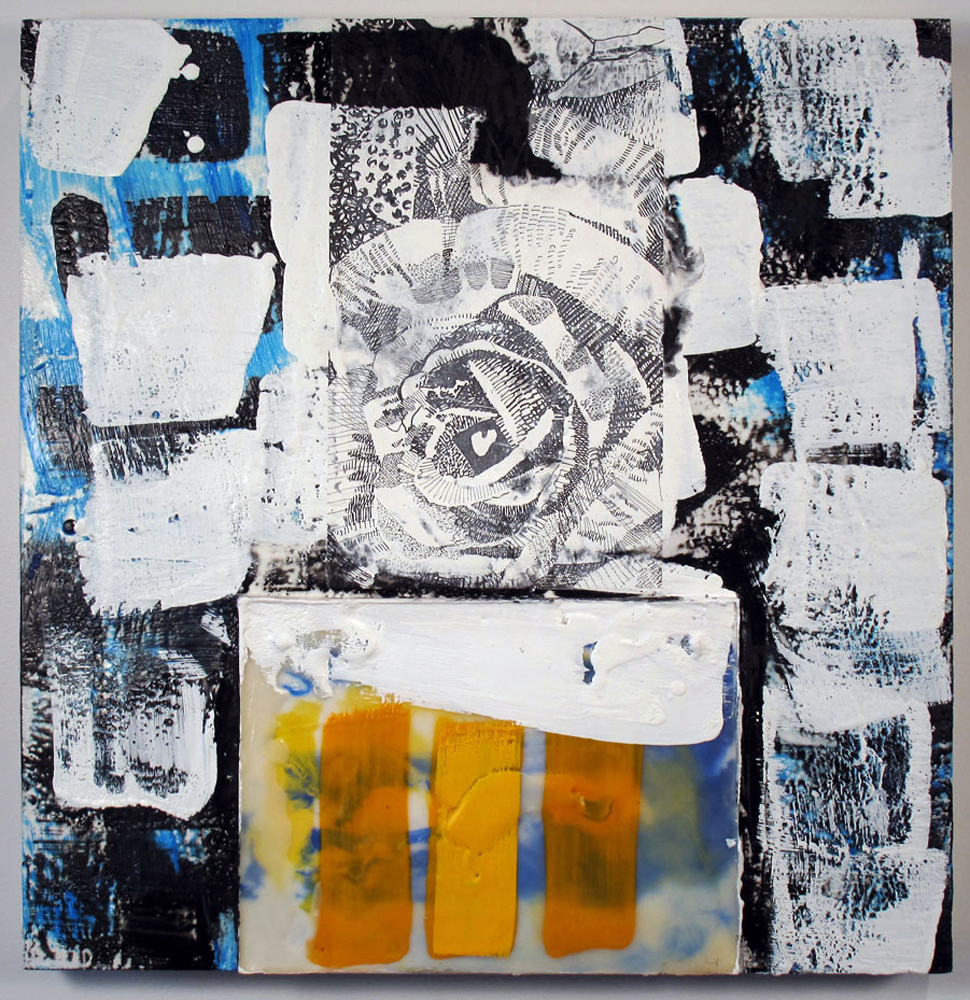 |
| Rose I, encaustic on panel, 23 by 22.5 inches (2009) |
TWO POEMS
by Théophile Gautier
English translations by composer Edward Lein here
VILLANELLE
Quand viendra la saison nouvelle,
Quand auront disparu les froids,
Tous les deux nous irons, ma belle,
Pour cueillir le muguet aux bois ;
Sous nos pieds égrenant les perles,
Que l'on voit au matin trembler,
Nous irons écouter les merles
Nous irons écouter les merles siffler.
Le printemps est, venu ma belle,
C'est le mois des amants béni,
Et l'oiseau, satinant son aile,
Dit des vers au rebord du nid.
Oh! viens, donc, sur ce banc de mousse
Pour parler de nos beaux amours,
Et dis-moi de ta voix si douce,
Et dis-moi de ta voix si douce : "Toujours".
loin, bien loin, égarant nos courses,
Faisant fuir le lapin caché,
Et le daim au miroir des sources
Admirant son grand bois penché ;
Puis chez nous, tout heureux, tout aises,
En panier enlaçant nos doigts,
Revenons rapportant des fraises
Revenons rapportant des fraises des bois.
 |
| Fragment from Yolanda's "Green and Still Moon" from the "Watercolor Revisited" show at Wayne State University (2011). Photo by Gilda Snowden. |
LE SPECTRE DE LA ROSE
Soulève ta paupière close
Qu'effleure un songe virginal!
Je suis le spectre d'une rose
Que tu portais hier au bal.
Tu me prise encore emperlée
Des pleurs d'argent de l'arrosoir,
Et, parmi la fête etoilée,
Tu me promenas tout le soir.
O toi qui de ma mort fus cause,
Sans que tu puisses le chasser,
Toutes les nuits mon spectre rose
A ton chevet viendra danser.
Mai ne crains rien, je ne réclame
Ni messe ni De Profundis,
Ce léger parfum est mon âme,
Et j'arrive du paradis.
Mon destin fus digne d'envie,
Et pour avoir un sort si beau
Plus d'un aurait donné sa vie;
Car sur ton sein j'ai mon tombeau,
Et sur l'albâtre où je repose
Un poête avec un baiser
Ecrivit: "Ci-git une rose,
Que tous les rois vont jalouser."


